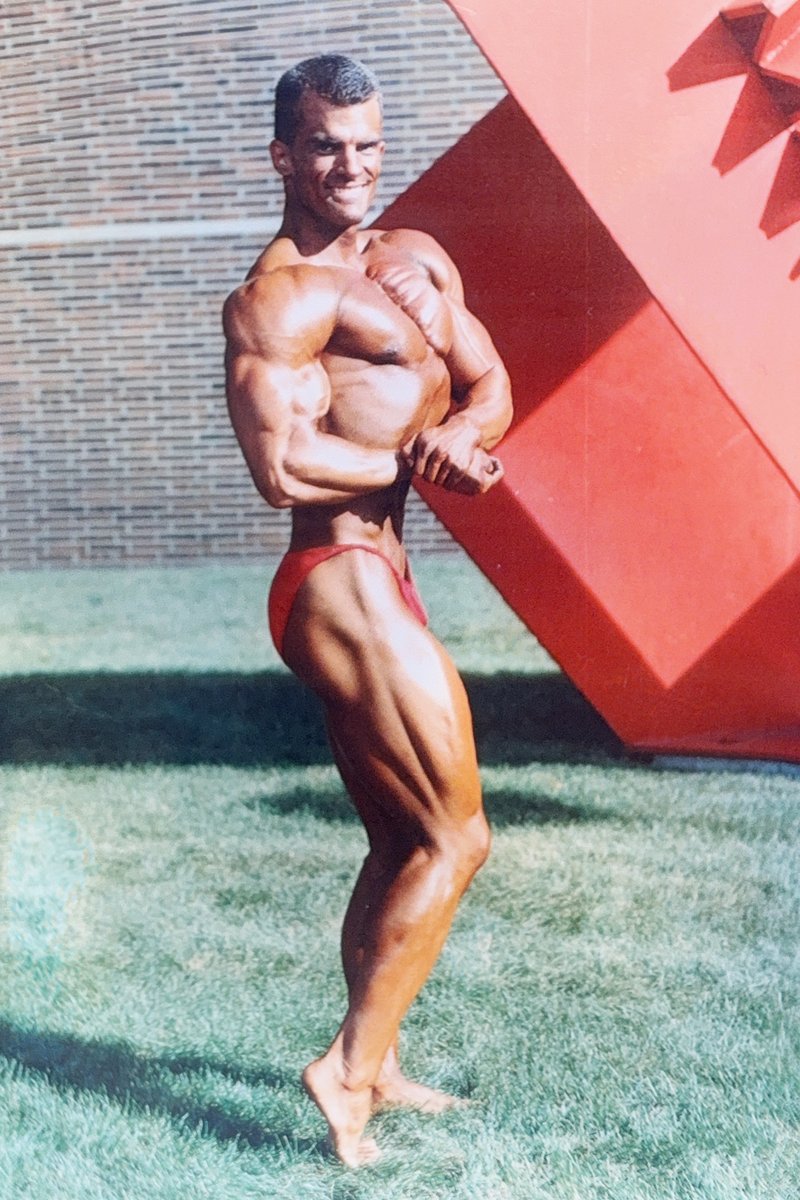
I've been in the gym since I was 14. I competed in natural bodybuilding at 17, won multiple titles, went nationally qualified, and ended up in Muscle & Fitness Magazine. I've trained through a full career, a divorce, and every version of a complicated adult life.
And somewhere in my late 30s, I was still training the way I trained in my 20s — and getting progressively worse results for it.
Not because I got lazy. Not because I stopped caring. Because the habits that built my physique in my 20s were actively working against me in my 40s — and nobody had told me that.
Here are the five I had to quit. If you're a man over 40 and your results have stalled, at least one of these is on the list.
Training to failure on everything, every session
When you're 24 and your testosterone is high and your recovery is fast, grinding every set to absolute failure feels like the only way to make progress. And for a while, it works.
After 40, it doesn't work — it accumulates.
Training to failure creates a significant amount of systemic fatigue. Your central nervous system takes the hit, not just the muscle. And at 40+, your CNS recovery is slower than it was a decade ago. What used to produce a training stimulus now produces a training debt you spend the next three days paying off.
I leave 1–2 reps in the tank on most working sets. I reserve true failure for the final set of isolation work, where the systemic cost is low. The volume is the same. The fatigue is a fraction.
Skipping the warm-up because "I don't have time"
I spent years treating the warm-up as optional — something you did if you had an extra 10 minutes, not something that changed what the workout actually produced.
After 40, skipping your warm-up doesn't just increase injury risk. It directly limits the quality of every set you do. Cold tissue doesn't recruit motor units efficiently. You're leaving performance on the table from rep one.
More importantly: the warm-up is where you signal to your body what's coming. It's not just physical — it's neurological. Men over 40 who skip it are doing 45 minutes of suboptimal work and wondering why they're not progressing.
10 minutes. That's all it takes. Movement prep for the primary pattern of the day — hip hinge, push, pull — followed by 2 progressively heavier sets before the first working set. The first working set now actually counts.
Dropping compound lifts because they "hurt"
Here's a pattern I see constantly: a man in his 40s has some knee discomfort, so he stops squatting. Has some shoulder tightness, so he stops pressing. Has some lower back sensitivity, so he stops hinging. Within a year he's doing nothing but machines and cables and wondering why he looks the same.
Discomfort is information. It's not a stop sign — it's a directional signal. The squat hurting your knees usually means your squat pattern is broken, not that you shouldn't squat. The press aggravating your shoulder usually means your setup is wrong, not that you should stop pressing.
Abandoning compound movements after 40 is one of the most expensive mistakes a man can make. These are the movements that maintain muscle mass, protect your joints long-term, and keep your hormonal environment working in your favor. Machines don't do that.
I fix the pattern before I abandon the movement. Narrow the stance, adjust the grip, reduce the range of motion temporarily, drop the load, and relearn it. Every man over 40 should be squatting, hinging, pressing, and rowing — just with the intelligence that comes from experience.
Doing cardio before lifting — or stacking them back-to-back
This one cost me years of results before I understood the physiology.
If you do cardio before lifting, you've depleted glycogen, elevated cortisol, and fatigued the motor units you need for strength training. Your weights session becomes a diminished version of what it should be.
If you do cardio immediately after lifting, you're competing with the anabolic signaling that just got triggered. Concurrent training — lifting and cardio back-to-back — can blunt the hypertrophic response. You're essentially telling your body two contradictory things at once.
After 40, when your hormonal environment is already less forgiving, this matters more than it did when you were 28.
Lift first, always. If I'm doing cardio the same day, I separate it by at least 6 hours. Ideally, cardio is on its own day. The sequence is not a preference — it's a mechanism.
Treating every training week the same
This is the one most men never figure out. They find a program, run it at the same intensity every single week, wonder why they plateau at week 6, and then blame the program.
Progressive overload is the non-negotiable driver of results. But progress isn't linear — and after 40, attempting to force linear progress every single week leads directly to overuse injuries, accumulated fatigue, and burnout. Your body needs deload weeks. Not because you're old. Because physiology works that way for everyone — and the margin for error gets smaller as you age.
A planned reduction in volume or intensity every 4th week isn't a sign of weakness. It's what allows you to actually keep training hard for the other three.
I plan my deloads before I need them. Every 4th week is a structured reduction — same movements, 60–70% of normal volume, lighter loads. I come back in week 5 stronger than I left in week 3. Every time.
None of these are complicated. They don't require a new program, a new gym, or a new supplement stack.
They require understanding that training after 40 isn't the same sport it was at 25 — and that the adjustments aren't compromises. They're upgrades.
The men who figure this out in their 40s look better at 50 than they did at 40. The ones who don't are still grinding the same sessions, wondering why the machine stopped producing.
You already have the discipline. You just need the right framework pointed at the right problems.
Refuse The Decline.